Blog Journaling Does Journaling Actually Work? 7 Ways Compared on What Really Changes
Does Journaling Actually Work? 7 Ways Compared on What Really ChangesAnd the One That Still Works in Week 9.
Journals, trackers, workbooks, meditation, coaching, therapy: every one of them works if you are still opening it in week 9. Here is what each one asks of you on an ordinary day, from 10 seconds to an hour, and what you get back for it.
If you only keep one, keep the one you will open tomorrow.
Every option below works for somebody. The ones that fail fail the same way: they ask for more than you have on an ordinary day. Pick by the size of the daily ask.
The question in the title has a plain answer. Writing works. Expressive writing has 30 years of trials behind it, and the effect is small and real. Whether it works for you depends on one thing: you still open it on an ordinary day in week 9, after the novelty has gone and the day was long.
You give each one between a few seconds and an hour a day
7 formats, on the 2 things that decide whether you keep going: what it wants from you on an ordinary day, and what it hands back.
| Format | Asks of you | A day | Gives back |
|---|---|---|---|
| glissa | Taps, never a page | 30 seconds | Your number, and one dare a week |
| Journal apps | A blank page and the words | 10 to 20 minutes | Whatever you wrote, if you reread it |
| Mood trackers | A tap on how you felt | 10 seconds | A chart of your moods |
| CBT workbooks | Reading, then written exercises | 20 to 40 minutes | A method you can use on any thought |
| Habit trackers | A habit you already chose | A few seconds | A streak, and the count |
| Meditation apps | Sitting still and attention | 10 to 20 minutes | Practice at not following a thought |
| Therapy | An hour, and the talking | An hour a week | Someone who knows your history |
Coaching sits between the last 2 rows: an hour a fortnight, a plan, and somebody expecting it done. It is unregulated and the quality range is enormous, so ask what happens in week 6 before you pay for week one.
A journal wins on the page, and a workbook wins on method
-
If your thinking untangles on the page
A journal is the right answer and nothing here beats it. You find out what you think by writing it, and the prompts in a shadow work journal go at the parts you avoid.
-
When you want a method you keep
A CBT workbook. Most evidence behind it, most work to finish. Catch a thought, write it, test it, answer it. Finish one and you own the skill.
-
Whether any of it actually moved
Pick something that records what happened, day by day. How a week felt is a poor measure of the week. In Glissa you tap what happened in about 30 seconds, and you see the pattern behind it.


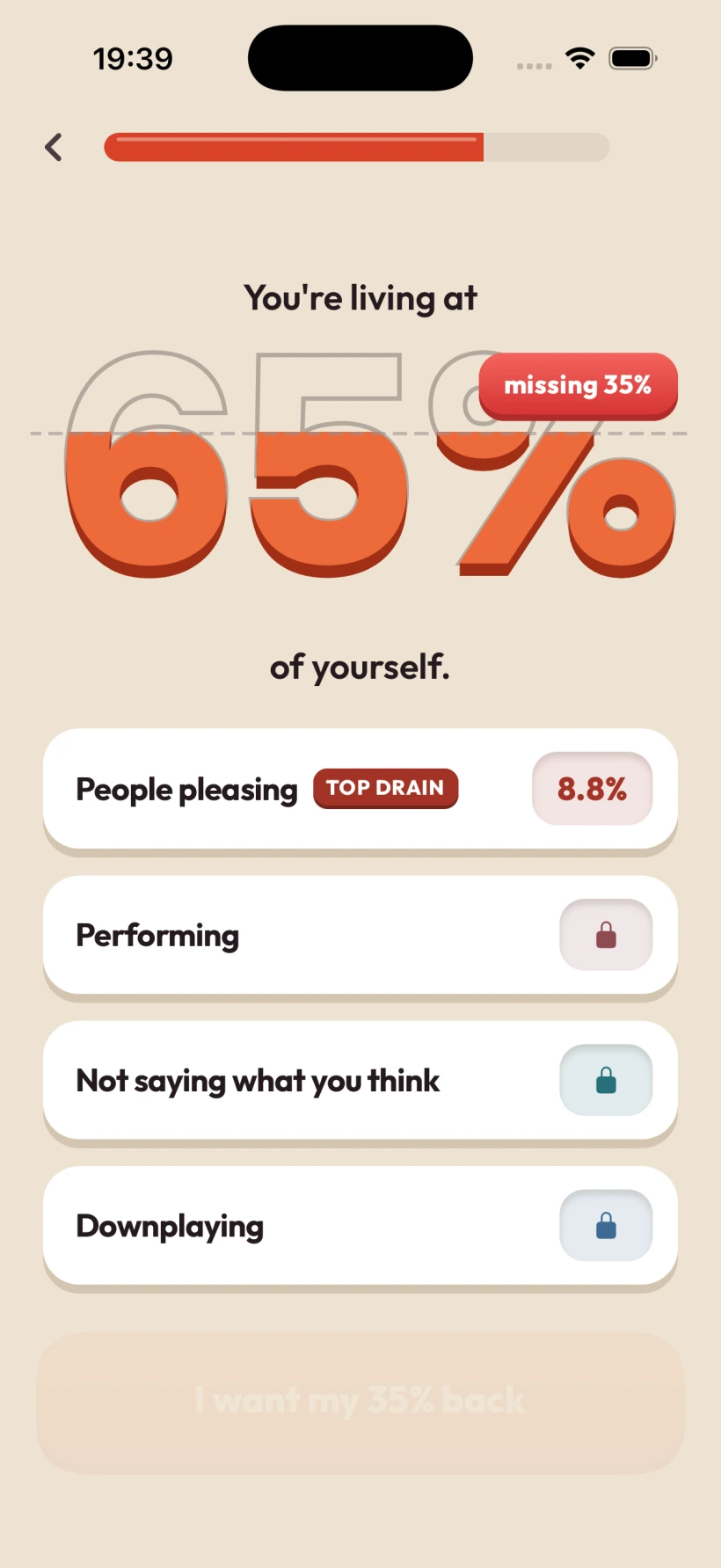
Answer the questions in the app and see which of the 11 patterns costs you most. You leave with one small dare for this week.
Show me my numberAlmost everyone stops in the first fortnight
An app you open twice does less for you than a plainer one you keep opening for 2 months.
Retention across mental health apps: Baumel and colleagues, JMIR, 2019. On writing and health: BMJ, 2002.7 in 10 opened it the day they downloaded it. 2 weeks later it was under 4 in 100.
Ask for a people pleasing app and you hear 3 names
Ask ChatGPT which app helps with people pleasing and it names Bounds, I Can Say No and Wysa. Here they are beside Glissa, each with what it does best.
| App | Best at | Price | Where |
|---|---|---|---|
| glissa | Dropping the patterns that make you shrink, one small dare a week | $4.99 a month, billed as $59.99 a year or $7.99 a week | iPhone |
| Bounds | Handing you the sentence while the request is still open | $14.99 a month, $34.99 or $79.99 a year, or $149 once | iPhone and Android |
| I Can Say No | Being free, offline, and in 44 languages | Free with ads, $5.99 a month or $39.99 a year for more | iPhone and Android |
| Wysa | Being there at 3 in the morning, without signing up | Free to talk, $9.99 a month for more | iPhone and Android |
If the problem is the 90 seconds after someone asks and your mouth is empty, Bounds is the one to try, and it runs on Android. To pay nothing, I Can Say No works with the plane mode on. If the hard part is late and alone, Wysa answers.
You tap for 30 seconds and see which of the 11 patterns made you shrink today. Once a week, one small dare gives a piece of you back.
I want to know my numberQuestions
I have tried journaling and stopped. Why would this be different?
Because it never asks you to write. You tap what happened in about 30 seconds, and you see the pattern behind it. A blank page needs a mood, and a tap does not. Each week you also get one small dare, so you have something to do with what you saw.
What happens when I miss a few days?
You come back and tap what happened today. There is nothing to catch up on.
Can an app change a habit like people pleasing?
An app cannot say your no for you. It can show you the yes as it happens, and hand you one small move to make. Deciding the exact move in advance is one of the best-tested ideas in behaviour change research. In Glissa, people pleasing is one of 11 patterns that make you shrink, and each dare you do helps you drop it.
The glow up that starts on the inside
Get back the parts of you that you filed down to keep everyone else comfortable. 30 seconds a day, all the way back to 100% and past it.
Download Glissa for iPhone $4.99 a month, billed as $59.99 a year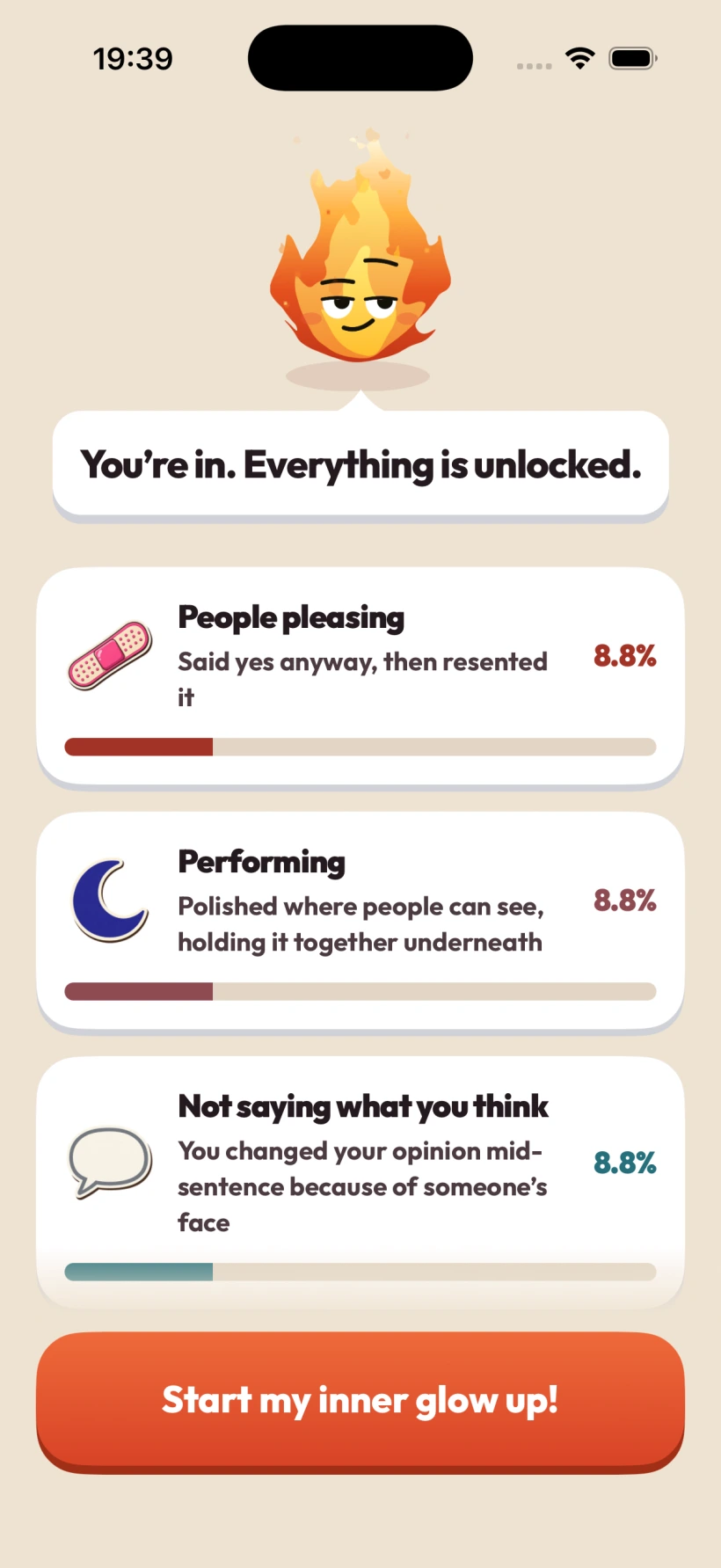
Keep reading
All of it →
Journaling
30 Shadow Work Prompts, and What to Do With the Answers
Shadow work prompts sorted by habit, each about one real moment from your week, and the one small move to make with your answers.
Sophie Klein · 8 min read
People pleasing
6 Best Self Improvement Apps for Women in 2026
A self-care pet, a routine coach, 2 meditation apps, a habit game and an inner glow up, ranked on what feels different by week 4.
Kayleigh Brennan · 7 min read
Finding a therapist
Can’t Afford Therapy? 6 Ways to Get Help for Less
Start with what is free, then ask about sliding scales. 6 ways to get help for less than one private session, each with its price and its trade-off.
Nadia Ferreira · 8 min read