Blog Finding a Therapist Can’t Afford Therapy
Can’t Afford Therapy?6 Ways to Get Help for Less.
If you can’t afford therapy, start with what is free: an employee assistance program through work, or a support group. Then ask a community health center or a university training clinic about a sliding scale. Some charge as little as $5 a session.
What can you do if you can’t afford therapy?
Start with what is free. Many employers pay for a few free counselling sessions through an employee assistance program, so check your benefits first. Then call a community health center or a university training clinic and ask about a sliding scale. Both set the fee by your income.
What private therapy usually costs
That is the market rate that Open Path, a nonprofit therapy network, gives for one session in the US. At one session a week, it comes to about $320 to $800 a month.
Open Path Collective, read 13 October 2026.
Most of the cheaper routes ask for something other than money: a wait, a trainee, a group, or a set number of sessions. Knowing the trade before you call saves you time.
Where can you get therapy for less?
These 6 routes run from free to about $70 a session. Each has a trade-off, and it sits right next to the price. Prices change, so check them when you call.
- 1Free sessions through workMany employers pay for a set number of free counselling sessions through an employee assistance program, often between 3 and 12, sometimes per problem. Ask HR or look in your benefits. The sessions run out, so use them for one clear thing.
- 2Community health centers, free to low costHealth centers funded by the federal government must offer a sliding fee if your income is up to twice the poverty line, and a full discount below it, apart from a small fee. Many offer counselling. Find one near you, then ask how long the wait is.
- 3University training clinics, from about $5Graduate students see clients under a licensed psychologist’s supervision, and the fee follows your income. One clinic charges $5 to $30 a session. Intake can close for part of the year, and most clinics cannot take a crisis.
- 4Sliding-scale networks, $40 to $70Open Path, a nonprofit, charges $65 once, then $40 to $70 a session with a licensed therapist, or $30 with a student intern. It is for people whose insurance does not cover therapy well, or who have none.
- 5Group therapy, less per personOne therapist works with a small group at the same time, so each person pays less than for a session alone. You share the hour, and you talk in front of others.
- 6Support groups and guided self-help, freeNAMI runs free peer support groups, many of them online. Guided self-help means a workbook or online course with short check-ins from a professional. Peers are not therapists, so this suits everyday struggles more than a crisis.
The quiz in Glissa gives you one number, the 11 patterns under it, and one small dare for this week.
I want to know my numberDoes cheaper therapy work as well?
Often, yes. A review of 23 studies found group therapy worked as well as one-to-one therapy. Another review, of 21 studies, found guided self-help worked about as well as face-to-face therapy for depression and anxiety.
-
Group therapy worked as well as one-to-one
A review pooled 23 studies that tested group and individual therapy side by side, for the same problems. The 2 formats came out about equal.
McRoberts, Burlingame and Hoag, 1998
-
Guided self-help matched face-to-face therapy
21 studies and 810 people with depression or anxiety compared the two. There was no real difference at the end of treatment, or up to a year later.
Cuijpers and colleagues, 2010
Both reviews measured whether people got better. Neither looked at cost. Fit with the person matters too, so if the first one is wrong for you, ask for someone else.
You can start dropping the pattern with Glissa while you wait
A therapist helps with where a pattern came from. The pattern itself turns up most days, in small moments, and that part you can start on tonight. Glissa is an inner glow up for women, built for those small moments. It does not treat anything, and it is not for a crisis.
| Compared on | glissa | Private therapy | A support group |
|---|---|---|---|
| Cost | $4.99 a monthbilled as $59.99 a year | $80 to $200 a session | Free |
| What you get | A number, 11 patterns and a dare | A trained ear | People who have been there |
| Who carries it | You, for 30 seconds | A trained person | The group |
| Day 30 vs day 1 | Each day’s check-in, kept | Your therapist remembers | Whatever you remember |
| Strongest at | Dropping the daily pattern | Where it started | Not feeling alone |
Private therapy rates: Open Path Collective. Day 30 retention on mental health apps: Baumel and colleagues, JMIR, 2019
On your iPhone, a ten-question quiz gives you one number for how much of you is showing right now. Then a thirty-second check-in each day spots the old patterns that dim you. Saying yes to everyone is one of 11.
Each week you get one small dare, written from your own answers, to help you drop the pattern costing you most. It costs $4.99 a month, billed as $59.99 a year, so a whole year costs less than one private session.
Get back the parts of you that you filed down to keep everyone else comfortable. It starts this week, with one small dare.
Show me my numberHow do you ask a therapist about price?
Ask before the first session, in writing. Ask if they have a sliding scale, and what their lowest fee is. If you are paying without insurance in the US, you also have the right to a written estimate of the cost before you start.
- 1Ask about a sliding scale“Do you have a sliding scale, and what is your lowest fee?” is a normal question to ask.
- 2Get the estimate in writingIn the US, people paying without insurance can ask for a good faith estimate before the first session.
- 3Space the sessions outFewer sessions cost less. Some therapists will move to every other week once the first few are done.
- 4Find out who else they would suggestIf they are full or too expensive, ask who they would send you to.
- 5Use the first call to check fitAsk if they offer a short free call first, and how they work with the thing that brought you there.
Questions
What if I need help right now?
If you are in crisis, call or text 988 in the US, at any hour, for free. Outside the US, call your local emergency number.
Is cheaper therapy worse therapy?
Not by default. Trainees work under licensed psychologists, and in the reviews above, groups and guided self-help did about as well as individual sessions. Fit with the person matters a lot, so change if it feels wrong.
Does insurance or Medicaid cover therapy?
Often, yes. Medicaid covers mental health care, and plans on the US marketplace must cover it too. What a plan pays for varies, so call the number on your card and ask about outpatient therapy.
Can an app replace therapy?
No. Glissa helps with the daily pattern. If you are struggling to cope day to day, talk to a doctor or try one of the routes above.
You can start with one call this week
Pick the route that fits your week and make one call, or send one email. If money is tight because you keep saying yes to everyone, how to say no without feeling guilty is the next read. Does journaling actually work? compares 7 ways to work on yourself, and every post on people pleasing is on one page.
Glissa is an inner glow up, 30 seconds a day on your iPhone, with one small dare a week.
The glow up that starts on the inside
Get back the parts of you that you filed down to keep everyone else comfortable. 30 seconds a day, all the way back to 100% and past it.
Download Glissa for iPhone $4.99 a month, billed as $59.99 a year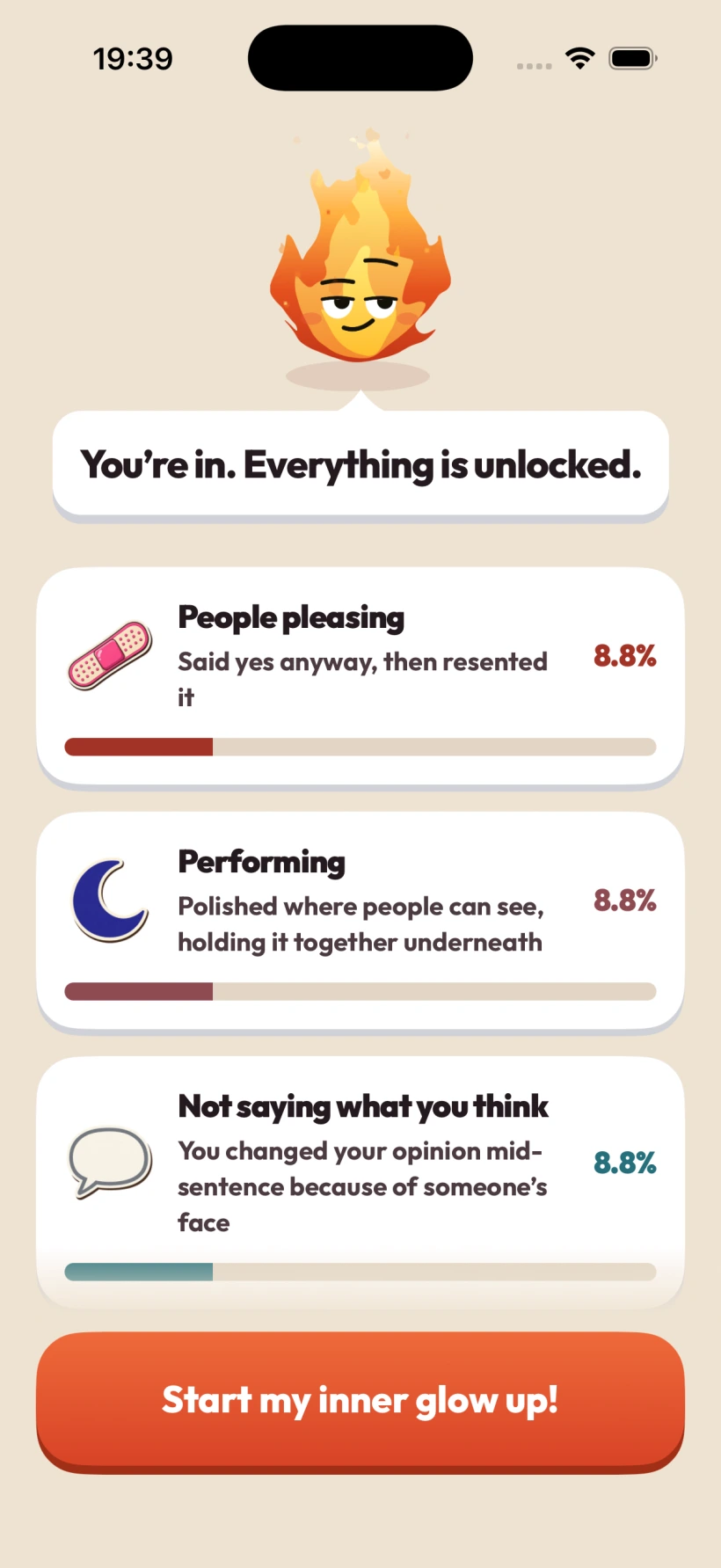
Keep reading
All of it →
Journaling
30 Shadow Work Prompts, and What to Do With the Answers
Shadow work prompts sorted by habit, each about one real moment from your week, and the one small move to make with your answers.
Sophie Klein · 8 min read
People pleasing
Eldest Daughter Syndrome: 8 Signs, and How to Let Others Help
Eldest daughter syndrome is what growing up as the family’s second parent leaves behind. 8 signs it shaped you, and how to let others help.
Kayleigh Brennan · 8 min read
People pleasing
How to Stop Caring What People Think: 7 Steps to Care a Little Less
Most people notice you far less than you think, and like you more. 7 small steps to care a little less about what they think.
Meg Turner · 7 min read