Blog Journaling 30 Shadow Work Prompts
30 Shadow Work PromptsAnd What to Do With the Answers.
Shadow work means looking at what you learned to hide, like the anger you swallow or a yes you never meant. Pick the habit that sounds like you, answer its 5 prompts, then try the one small move at the end.

What does shadow work mean?
Shadow work means looking at the parts of yourself you learned to keep out of sight. The psychiatrist Carl Jung called them the shadow: feelings and wants that did not fit the person you were expected to be. For many women, that means anger, envy and needs of their own.
It sounds bigger than it is. In practice, you take one moment from your week and ask what you did not let yourself feel.
“Too basic, already answered questions.”
That is how one reader described the journal prompts in a 2025 book on fawning. Most prompt lists ask about your life in general, and you already know those answers. Every prompt below asks about one real moment from the last 7 days, and comes with a second question to go further.
They sit in 6 groups, one for each habit that grows in a life spent keeping everyone else comfortable.
 People pleasingAgreed before you had decided
 Not saying what you thinkChanged your opinion when you saw their face
 DownplayingCalled it nothing when it was something
 Losing yourselfStopped knowing what you like
 Hyper-independenceDid it alone so nobody was put out
 Being everyone’s therapistListened to everyone and kept yours to yourself
Which shadow work prompts should you start with?
Start with the group for the habit you recognised first. Answer its 5 prompts about the last 7 days, one moment each. Write for 10 minutes, then stop. Each group ends with one small move to try this week.
The yes you did not mean
- 1Write down the last time you agreed to something you did not want.Who asked, and what would you have said if it cost you nothing?
- 2Think of a time you said yes before they finished asking.What were you afraid would happen if you waited?
- 3Whose disappointment do you work hardest to avoid?Note the last plan you changed to avoid it.
- 4List 3 things you did this month that nobody asked you to do.Which one did you resent?
- 5Describe the hour after your last no.What did you feel, and how long did it last? If you cannot remember a no, write why.
Then say one small no this week, to something that costs you nothing. A second drink or a call you do not want to take will do.
The opinion you swallowed
- 6Recall the last time you changed your opinion halfway through a sentence.Whose face made you change it?
- 7Write the thing you wanted to say at a recent dinner or meeting.Say it now, on the page, in one sentence.
- 8Who do you agree with most easily?Write one thing you see differently from them.
- 9Pick a choice this week where you said you did not mind.What did you mind?
- 10Name a subject you avoid with your family.What do you think about it that you have never said?
Then say one real opinion out loud this week, about something small: a film, a restaurant, the route home.
The need you played down
- 11When did you last say you were fine when you were not?What would the true answer have been?
- 12Describe a win you mentioned quickly so nobody would think you were showing off.Now write it again, the long way.
- 13List what you need this week that you have not asked for.Circle the smallest one.
- 14Think about the last time you said sorry for taking up space.A seat, a minute, a question. What were you sorry for?
- 15Which feeling do you hide fastest?Anger, sadness, envy or pride. When did it last show up?
Then answer one how-are-you honestly this week. One true sentence is enough.
The things you used to love
- 16Name 3 things you loved doing before your current relationship or job.Which one have you not done this year?
- 17Who chose the last 5 things you watched or listened to?Write one you would have picked.
- 18Describe your ideal weekend if nobody else’s plans counted.How close was your last one?
- 19Think of an opinion you dropped because a partner or friend disagreed.Do you still hold it?
- 20Make a list of 10 things you like, without stopping to check.Notice which ones took longest to find.
Then do one thing from that list this week, on your own, for an hour.
A short test in the app gives you one number, the 11 habits under it, and one small dare for this week.
I want to know my numberThe help you would not take
- 21When did someone last offer to help, and you said you were fine?What would it have cost you to say yes?
- 22Recall a time you asked for help and it went badly.How old were you, and who was there?
- 23List the jobs at home or at work that only you do.Which could someone else do their way?
- 24Whose help is hardest for you to accept?Write what you think they would want back.
- 25Picture asking a friend for a lift or a favour.Write the exact words you would use, and what you fear she would think.
Then ask one person for something small this week, before you need it.
The listening you never got back
- 26Who called you last with a problem?When did you last call them with yours?
- 27Write about a time you shared something hard and the subject changed.What did you decide about sharing after that?
- 28List the friends who ask how you are and wait for the answer.If the list is short, write about why.
- 29Think of the last conversation you spent managing someone else’s mood.What were you feeling while you did it?
- 30Describe what you would want from a friend on a bad day.Who could give you that, if you asked?
Then tell one friend one true thing about your week, and let her answer.
Does writing about your feelings help?
It helps a little. A review of 146 studies found a small benefit from writing or talking about hard experiences. In a lab study, putting a feeling into words also calmed the brain’s alarm response. Going over the same hurt in circles is a different thing.
-
Writing about hard things helped a little
A review pooled 146 studies in which people wrote or talked about difficult experiences. On average it helped, across measures of health, mood and daily life. The effect was small, and it held.
Frattaroli, 2006
-
Naming a feeling quietened the brain’s alarm
People looked at photos of angry and scared faces. When they chose a word for the feeling, activity in the amygdala, the part of the brain that reacts to threat, went down.
Lieberman and colleagues, 2007
The going round in circles has a name. Researchers in 1999 separated rumination, dwelling on a hurt again and again, from reflection, which comes from curiosity. Rumination went with more distress. That is why every prompt here asks about one moment, then asks one more question, then hands you something to do.
Neither study was run on women filling in a notebook, so take them as a guide.
You can write in a notebook, talk to a therapist, or let Glissa count the habit
A notebook costs almost nothing and keeps what you write. A therapist can go into where a habit started. The habit itself shows up most days, in small moments between the two. If you are not sure writing works for you, does journaling actually work compares 7 ways.
| Compared on | glissa | Therapy | A notebook |
|---|---|---|---|
| Cost | $4.99 a monthbilled as $59.99 a year | A session a week | The price of a notebook |
| What you get | A number, 11 habits and a dare | A trained ear | Your own words |
| Who carries it | You, for 30 seconds | A trained person | You, alone |
| Day 30 vs day 1 | The same questions, counted | Your therapist remembers | Whatever you reread |
| Strongest at | Changing the habit | Where it started | Seeing it in writing |
The orange column is ours. Day 30 retention on mental health apps: Baumel and colleagues, JMIR, 2019
Glissa is the iPhone app for women who look after everyone first. A short test gives you one number for how much of you is showing. 11 habits sit under it, re-scored every week, so day 30 sits beside day 1.
Every week it hands you one dare from your own answers, sized to be doable. The prompts show you where the habit lives. The dare is how you start to change it.
Get back the parts of you that you filed down to keep everyone else comfortable. It starts this week, with one small dare.
Show me my numberWhat should you do with your answers?
Turn one answer into one small move this week. Read what you wrote the next day and circle the habit it shows. Then pick the smallest move against that habit, do it once, and write down what happened.
- 1Read it back the next dayA day later, the moment is easier to look at.
- 2Circle the habitMost answers point to one of the 6 groups. Pick the one that shows up most.
- 3Choose the smallest move against itOne small no, one honest answer, one ask. Small enough to do this week.
- 4Write down what you fear will happenGive it a date. A fear with a date can turn out wrong.
- 5Do it once, then comparePut what happened next to what you feared, in writing.
Questions
Is shadow work safe to do on my own?
For everyday habits like these, yes. If a prompt brings back something that overwhelms you, stop there and talk to a therapist or a doctor. If you are in crisis, call or text 988 in the US, or your local emergency number.
What if I do not know what to write?
Pick one moment from today and write 3 lines: what happened, what you felt, and what you did. That is enough to start.
Why do I feel worse after writing?
Some people do at first. In the early writing studies, people who wrote about hard experiences felt worse straight after, and visited the doctor less in the months that followed. If it keeps getting worse, stop and talk to someone.
How often should I do it?
10 minutes, a few times a week, is plenty. More is not better if you are going over the same thing in circles.
You start with the group you recognised first
Answer one prompt from that group tonight. If people pleasing came up most, how to stop being a people pleaser is the next read. If it was the things you used to love, start with how to find yourself again. Where people pleasing starts covers the childhood questions.
Glissa takes 30 seconds a day on an iPhone, and gives you one small dare a week.
The glow up that starts on the inside
Get back the parts of you that you filed down to keep everyone else comfortable. 30 seconds a day, all the way back to 100% and past it.
Download Glissa for iPhone $4.99 a month, billed as $59.99 a year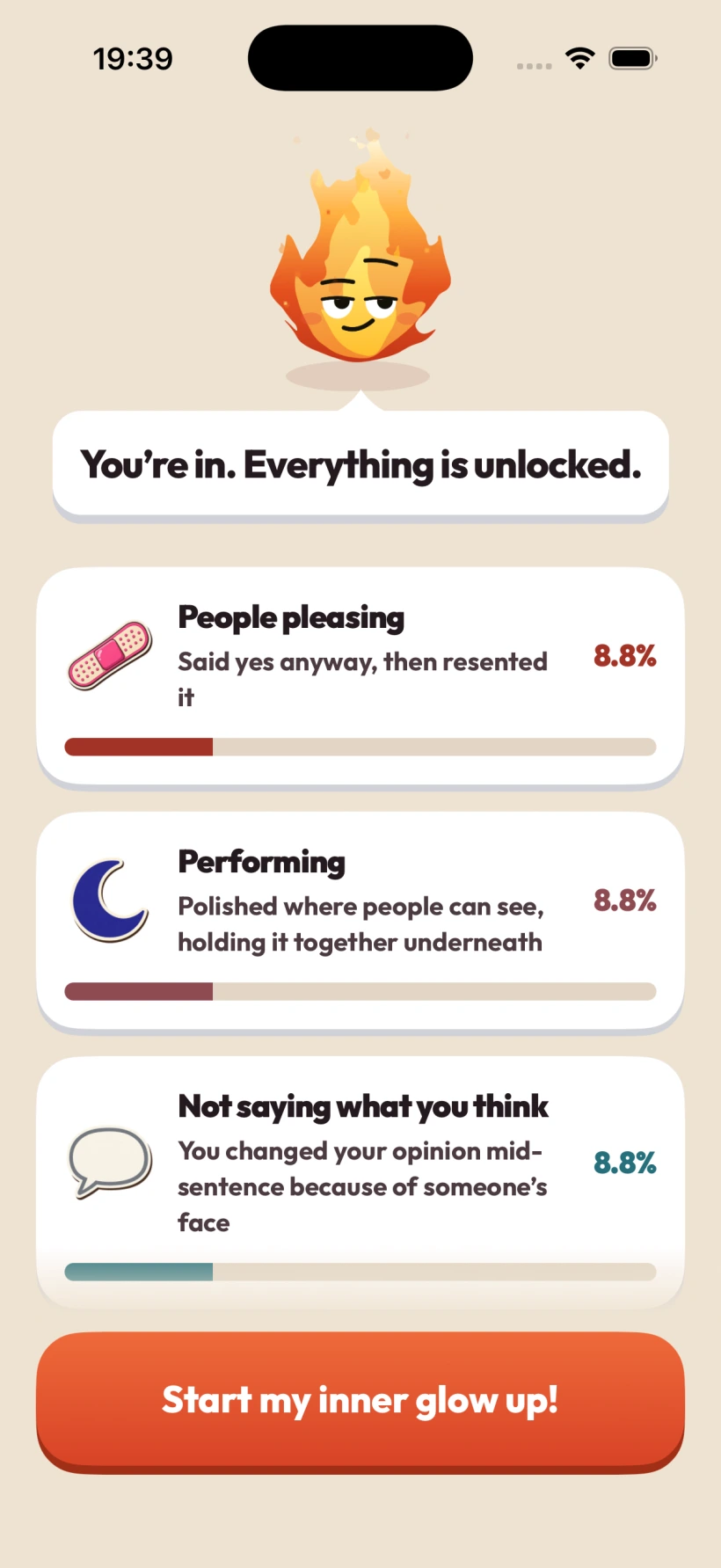
Keep reading
All of it →Journaling
Does Journaling Actually Work?
Journals, workbooks, therapy, and how much of you comes back for what each one takes. Most do not survive week 2.
9 min read
People pleasing
Eldest Daughter Syndrome: 8 Signs, and How to Let Others Help
Eldest daughter syndrome is what growing up as the family’s second parent leaves behind. 8 signs it shaped you, and how to let others help.
8 min read
People pleasing
How to Stop Caring What People Think: 7 Steps to Care a Little Less
Most people notice you far less than you think, and like you more. 7 small steps to care a little less about what they think.
7 min read